Clear Page Roles
Each page should own a distinct audience, search intent and commercial or educational purpose.

Organize service pages, lawyer profiles, topic hubs, resources and internal links as one coherent system that helps the right prospects discover, understand and navigate your firm.
Save or follow this source
Add AdvocateRahulDev.com to Google Preferred Sources or open this page in your preferred AI tool.
Identify structural gaps that may be limiting visibility, authority flow, user navigation or the connection between search demand and commercial pages.
Discuss Law Firm Seo Architecture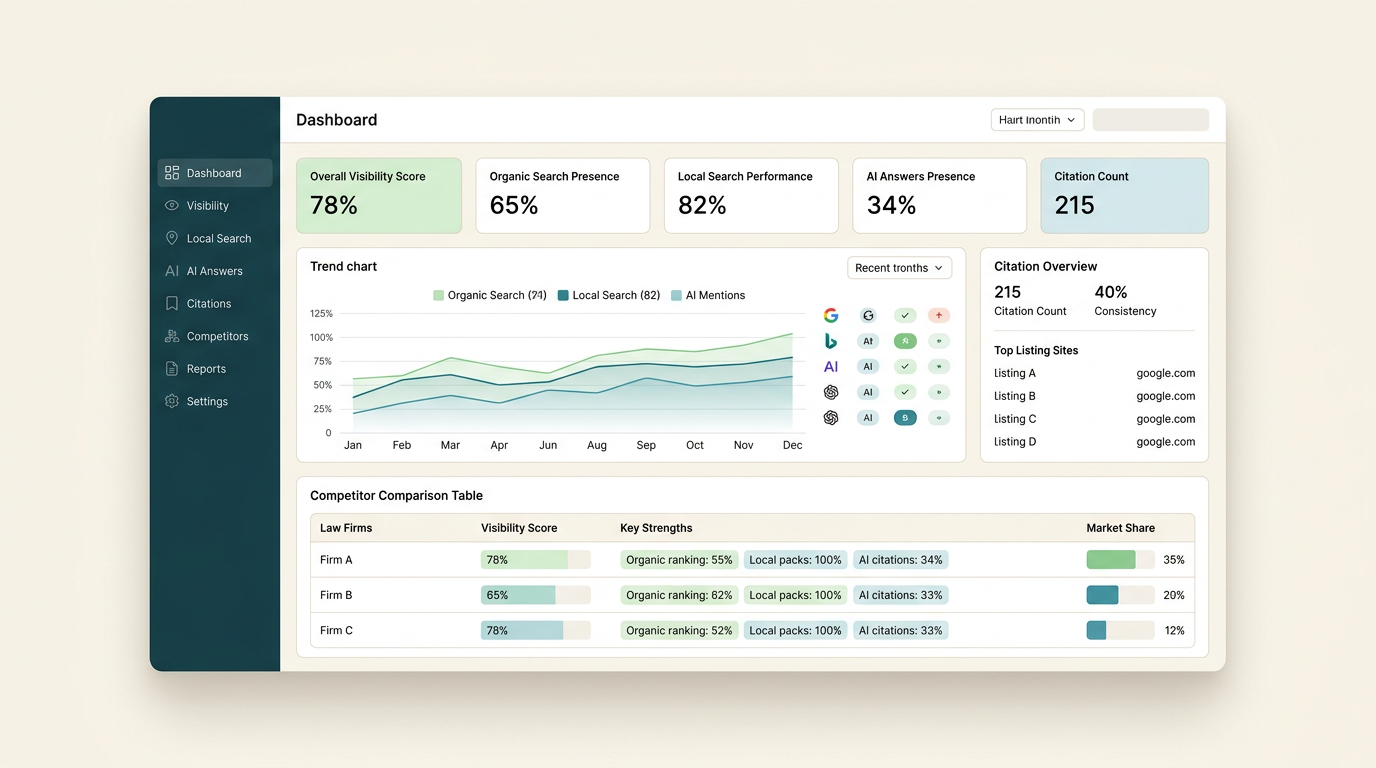
Optimising individual pages is not enough when the wider website lacks clear page ownership, logical hierarchy or useful internal relationships. Law-firm SEO architecture defines how service pages, lawyer profiles, locations, topics, resources and insights work together.
Each page should own a distinct audience, search intent and commercial or educational purpose.
Folders and navigation should help users and search systems understand how major subjects relate.
Contextual links should connect commercial pages, topic hubs, resources, profiles and insights.
Architecture should reduce cannibalisation and remain manageable as the site expands.
Creating multiple pages for small keyword variations can fragment relevance and increase maintenance risk. Architecture should begin with distinct intent, not page volume.
SEO performance is shaped by the relationships between pages, not only by the optimisation of individual pages.
Identify structural gaps that may be limiting visibility, authority flow, user navigation or the connection between search demand and commercial pages.
Discuss Your Growth PrioritiesTranslate the analysis into a focused review, roadmap or implementation decision without overstating likely outcomes.
The lower section examines the issue in detail, distinguishes verified facts from strategic interpretation and links to relevant sources, topic guides and practical resources.
Last updated: August 2, 2026
Every important page should have a defined role. Service pages explain what the firm does, lawyer profiles establish who does the work, location pages address genuine geographic relevance, topic hubs organise educational authority and resource pages solve practical user problems.
A logical hierarchy helps explain the relationship between broad hubs and specific pages. Structure should reflect user intent and content ownership, not simply mirror every keyword variation.
These page types serve different purposes and should not be collapsed into near-duplicate versions of the same text. Clear separation reduces cannibalisation and improves relevance.
A hub should summarise a broad subject and connect to narrower pages. Supporting pages should deepen one question, tool, jurisdiction or use case and link back to the hub.
Links should move users naturally from explanation to action: topic to resource, resource to solution, lawyer profile to authored content and service page to relevant proof or guidance.
Before adding a new page, the firm should check whether an existing page already owns the intended query or task. Merging, redirecting or expanding an existing page may be stronger than publishing another similar page.
Redesigns and migrations should preserve valuable URLs where possible, map redirects, verify canonicals and avoid leaving old pages accessible in conflicting forms.
Architecture is not a one-time decision. New services, lawyers, locations and content can create overlap unless page ownership and internal links are reviewed periodically.
This claim should not be presented as established fact. The page should explain the limitation and use qualified language.
This claim should not be presented as established fact. The page should explain the limitation and use qualified language.
This claim should not be presented as established fact. The page should explain the limitation and use qualified language.
This claim should not be presented as established fact. The page should explain the limitation and use qualified language.
This article combines current public guidance, official platform documentation where relevant, and ARD strategic interpretation. Verified facts, analytical conclusions and practical recommendations should remain clearly distinguishable.
It means designing page roles, hierarchy and internal relationships so that each page serves a distinct purpose and supports the wider site.
It matters because individual page optimisation cannot compensate for duplicated intent, weak navigation or disconnected content.
Common mistakes include creating a separate page for every keyword, duplicating city pages and leaving important pages isolated.
Prioritise page ownership, navigation, indexation and internal links before expanding content volume.
Specialist support is useful during redesigns, migrations, large-scale content expansion or persistent cannibalisation problems.
Translate the analysis into a focused review, roadmap or implementation decision without overstating likely outcomes.
Additional context on legal technology, search visibility, AI discovery and digital growth for law firms.
A strong strategy for Law Firm SEO Architecture begins with the questions a prospective client or referring professional needs answered before taking the next step. The page should make the relevant firm, lawyer, service, jurisdiction and evidence relationships explicit. Important claims should be easy to verify from the visible page and, where appropriate, from authoritative external sources. This creates useful material for ordinary search, direct readers and AI-assisted discovery without assuming that any platform will surface or cite the page. The durable objective is clarity, accuracy and retrieval quality, because those factors remain valuable even when interfaces, ranking systems or answer products change.
Work on Law Firm SEO Architecture should distinguish whether a page can be crawled and interpreted from whether it deserves to be selected as a useful source. Canonicals, internal links, structured data and performance can support eligibility, but they do not create expertise by themselves. The editorial layer still needs a clear answer, appropriate scope, current evidence and enough context for a passage to remain accurate when read independently. Separating these layers helps diagnose problems more effectively. A technically sound page may still need stronger evidence or information gain, while an excellent article may remain difficult to discover if the site architecture isolates it.
For Law Firm SEO Architecture, internal links work best when they show how a user can move from a broad question to a more specific decision. Parent pages can establish the main subject, child pages can answer narrower needs and related pages can connect adjacent questions without creating multiple URLs for minor query variations. Anchor text should describe the destination rather than repeat an identical phrase everywhere. This structure helps readers continue their research and gives retrieval systems a clearer picture of how the site's entities and subjects relate. It also reduces orphan pages and makes later content expansion easier to manage without relying on a flat list of disconnected articles.
A page addressing this topic should be reviewed for two separate qualities: whether the material is technically available for retrieval, and whether the passage itself is clear enough to be trusted and reused. Confirm that the page is crawlable, internally linked and canonically consistent, then inspect the substantive sections for explicit entities, scoped claims, current evidence and visible qualifications. Important statements should still make sense when read outside the surrounding page. This produces content that is useful to a human reader and easier for search or AI systems to interpret, without assuming that technical markup or a preferred-source action can guarantee ranking, citation or inclusion in an answer.
Identify structural gaps that may be limiting visibility, authority flow, user navigation or the connection between search demand and commercial pages.
Plan the Next Step with Dr. Rahul Dev