Law Firm Websites
Build a clearer, faster and more persuasive digital foundation for trust, usability and conversion.
Explore this topic
A structured guide to the websites, search, AI, content, technology, reputation and conversion topics shaping modern law-firm growth.
Save or follow this source
Add AdvocateRahulDev.com to Google Preferred Sources or open this page in your preferred AI tool.
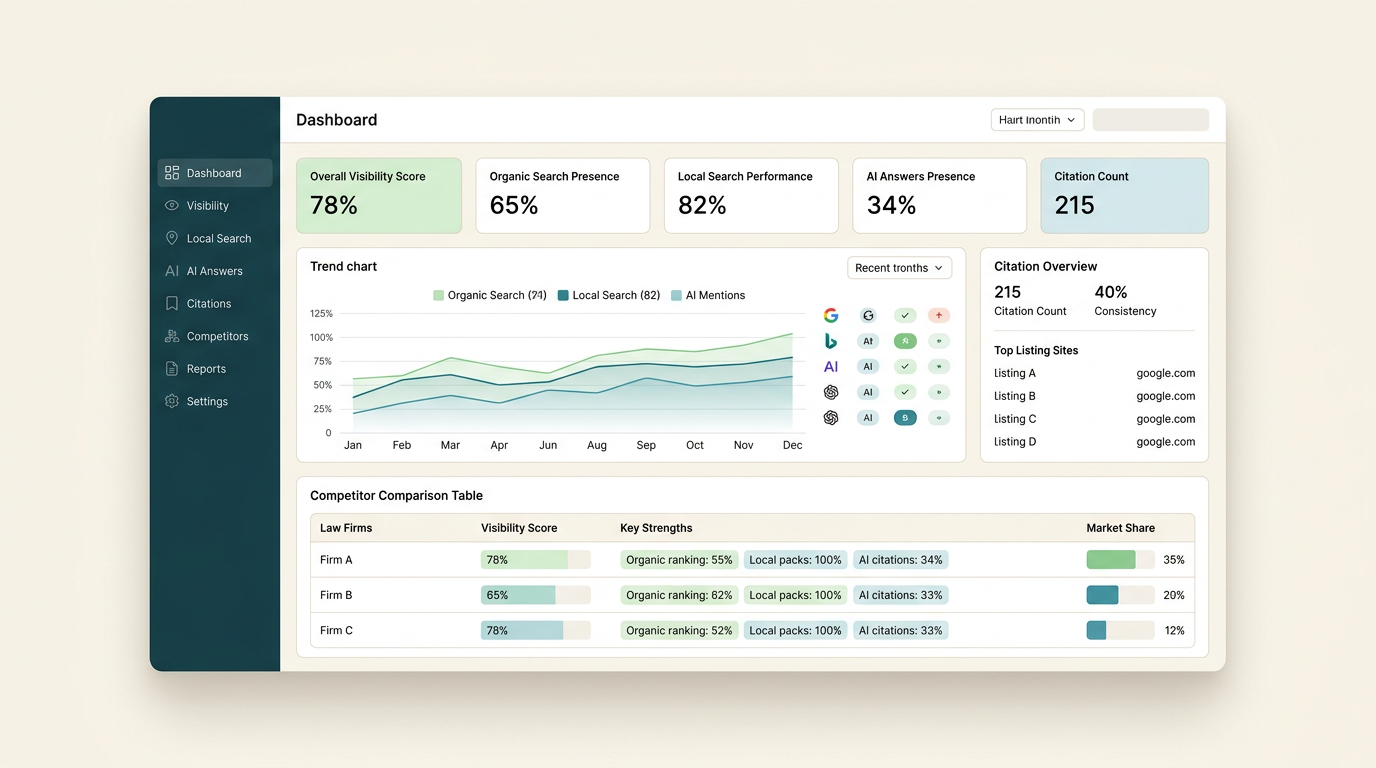
Use the topics below to identify the area most likely to affect your firm’s visibility, client acquisition, conversion or digital operations, then discuss the next practical step around that outcome.
Discuss Your Law Firm Growth Priorities
Each topic supports one or more stages of the client journey, from being discovered and trusted to converting enquiries and improving digital operations.
Build a clearer, faster and more persuasive digital foundation for trust, usability and conversion.
Explore this topicImprove discoverability across relevant searches through technical quality, topical authority and useful content.
Explore this topicMake the firm’s expertise easier for AI-driven discovery systems to interpret, retrieve and reference.
Explore this topicCreate research-led content that supports discovery, evaluation, authority and client decision-making.
Explore this topicStrengthen visibility where prospective clients search for legal services in specific markets and locations.
Explore this topicUse AI, automation and digital workflows to improve efficiency, client experience and growth capacity.
Explore this topicClarify positioning, expertise and trust signals so prospects can understand why the firm is relevant.
Explore this topicImprove the path from interest and enquiry to meaningful consultation and client engagement.
Explore this topicConnect search, content, profiles, evidence and reputation into a stronger overall market presence.
Explore this topicLaw Firm Websites → Law Firm Branding → Local SEO → Legal Content Strategy → Client Intake
Lawyer SEO → Legal Content Strategy → Digital Authority → AI Search Visibility → Practice and Market Growth
Client Intake → Legal Technology → AI Visibility → Automation → Conversion Optimisation
| The website does not build trust | Law Firm Websites and Branding |
| Priority services do not appear in search | Lawyer SEO |
| The firm is unclear about AI search | AI Search Visibility |
| Publishing is inconsistent | Legal Content Strategy |
| Local enquiries are weak | Local SEO and Google Business Profile |
| Enquiries do not convert | Client Intake and Conversion |
If several issues overlap, connect website, search, AI visibility, content, intake and technology into one prioritized growth plan rather than treating each channel separately.
Discuss an Integrated Growth PlanFrom research to implementation
Use AdvocateRahulDev.com to understand the problem, compare approaches and identify priorities. When your firm needs implementation support, Councl for Law Firms provides a connected pathway across digital presence, search and AI visibility, content architecture, client discovery and growth systems.
Last updated: July 31, 2026
The Topics hub is the evergreen knowledge map for AdvocateRahulDev.com. It explains how law-firm websites, search visibility, AI discovery, content, local presence, branding, technology and client intake work together across the journey from discovery to enquiry.
The website is the central owned platform in the client-discovery journey. It should explain who the firm helps, what services it provides, where it operates, who its lawyers are and what action a visitor should take next.
Website strategy includes architecture, navigation, service pages, lawyer profiles, locations, content hubs, accessibility, performance, mobile usability and conversion.
This topic is the appropriate starting point for new firms, redesigns and sites whose structure no longer reflects the practice.
Lawyer SEO covers the technical, structural and editorial work required for relevant pages to appear in search. It includes crawlability, indexation, keyword intent, page differentiation, internal links, content depth, local search and measurement.
The central question is not how many keywords can be placed on a page. It is which page should answer a particular query and whether the site provides enough evidence, clarity and supporting context to justify visibility.
This topic is most relevant to firms with defined services and markets that are not being discovered consistently.
AI search visibility concerns whether a law firm’s expertise can be interpreted accurately by AI-driven discovery systems. Important elements include entity clarity, authorship, direct answers, page roles, structured information, source quality and consistency across public profiles.
AI visibility should be built on sound SEO and content foundations. It is not a replacement for technical accessibility, useful content or professional credibility.
This topic helps firms understand how search behaviour is changing and how to make their information clearer without relying on unsupported promises.
Legal content strategy defines the purpose and relationship of service pages, topic hubs, practical resources and dated insights. Each format should answer a different user need and support a defined place in the site architecture.
Research-led content can educate prospective clients, demonstrate expertise, strengthen search relevance and support AI readability. It should remain accurate, specific, useful and visibly authored.
This topic is relevant to firms that publish inconsistently, rely on generic blog posts or lack a clear subject-matter structure.
Local SEO concerns how a firm appears for geographically relevant searches. It may involve Google Business Profile, maps, reviews, office information, location pages, citations and local internal links.
Location pages should provide genuine local context rather than repeat the same generic text for multiple cities. The content should explain the office, service area, professionals, practical access and jurisdictional relevance where appropriate.
This topic is especially important for firms serving consumers, local businesses or clients who prefer a nearby legal provider.
Legal technology includes the tools and systems used for research, drafting, review, case management, client intake, automation, knowledge management and professional communication.
The strategic question is not whether a tool uses AI. It is whether the tool solves a defined problem, integrates with existing workflows, protects sensitive information and produces an outcome that can be reviewed and governed.
TechCorpLegal and TechLaw.Attorney provide specialist context for technology-law, legal-tech and related regulatory developments.
Law-firm branding is the consistent presentation of the firm’s identity, positioning, expertise and professional character. It influences how prospective clients compare the firm with alternatives.
Trust is supported by clear profiles, useful content, accurate credentials, consistent visual presentation, accessible contact information, third-party validation and realistic claims.
Councl provides a specialist platform for structured law-firm profiles and public-facing visibility context.
Client intake begins before a form is submitted. It includes the clarity of the offer, the relevance of the page, the visibility of contact options, consultation expectations, mobile usability and the handling of confidential information.
Conversion strategy should match the visitor’s stage. A user reading a general guide may need a related resource, while a user on a service page may be ready to contact the firm.
The objective is to make the next step clear without using exaggerated claims or unnecessary pressure.
A new or rebuilding firm should usually begin with website architecture, branding, client intake, local SEO and legal content. An established firm seeking growth may begin with lawyer SEO, content strategy, digital authority, AI visibility and conversion. A technology-focused practice may prioritise legal technology, AI visibility, automation, technical SEO and research-led content.
These paths are not mandatory sequences. They are practical starting points that help readers avoid treating every topic as equally urgent.
The Topics hub explains the subject. The Resources hub helps apply it. The Insights hub tracks developments. The Solutions hub supports implementation and advisory work.
The main topics include law firm websites, lawyer SEO, AI search visibility, legal content strategy, local SEO, legal technology, branding, digital authority, client intake and conversion.
A new firm should usually begin with website structure, positioning, lawyer profiles, client intake, local visibility and a focused legal-content plan.
Lawyer SEO focuses on technical and editorial factors that influence search discovery. AI search visibility focuses on whether the firm’s information is clear, structured, distinctive and supported well enough for AI systems to interpret.
It gives each page a defined role, prevents duplication, supports topical authority, improves client education and creates clearer information for search engines and AI systems.
Topic hubs organise related guidance, help users navigate complex subjects, strengthen internal links and connect educational content with practical resources and relevant solutions.
Choose the subject that matches the current problem, then move to the relevant resource or solution.
Additional context on how legal technology, search visibility, AI discovery, content and digital systems increasingly connect across law-firm growth.
Dr. Rahul Dev is a PhD Data Scientist, Technology Law and Patent Attorney, AI Educator, and international business advisor with more than 20 years of professional experience. His work spans artificial intelligence, emerging technology, intellectual property, digital growth, technical research, and business strategy. He advises law firms, founders, CEOs, and CXOs on how technology, content, data, and legal systems influence authority, visibility, innovation, and commercial growth.
Connect on LinkedIn, explore more here, contact here, or send email at hi (at) meetrahuldev (dot) com.
Choose the visibility, acquisition, conversion or technology challenge that matters most now and identify the practical next steps worth prioritizing for your firm.
Discuss Your Next Growth PriorityBrowse the complete published topics library.