Search Discovery
Indexation, crawlability, titles, descriptions, canonicals, sitemaps, internal links and search-performance signals.

Identify where the firm is being found, overlooked or losing opportunities across search, AI discovery, websites, professional profiles, trust signals and client-intake pathways.
Save or follow this source
Add AdvocateRahulDev.com to Google Preferred Sources or open this page in your preferred AI tool.
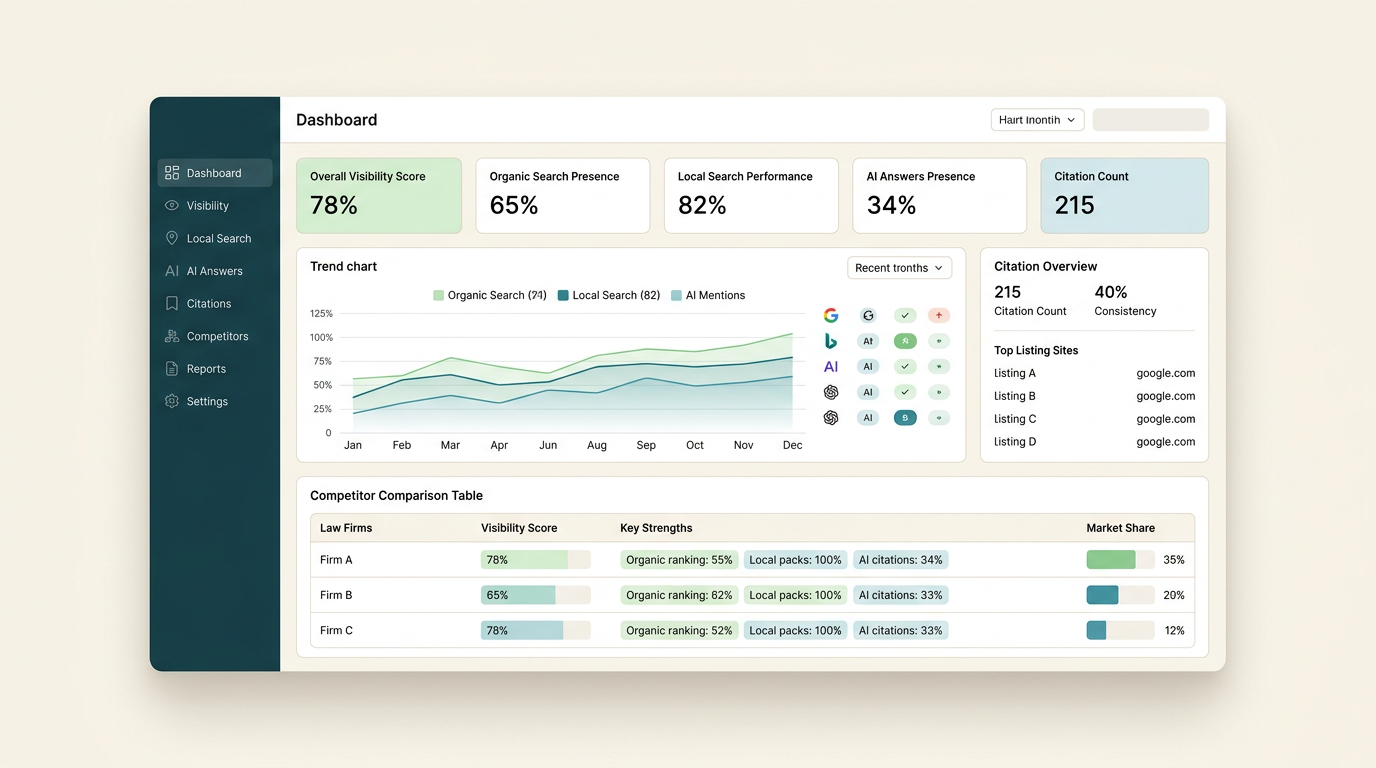
Use a structured review to identify visibility, trust, website and intake gaps before committing more budget or resources to isolated marketing initiatives.
Request a Law Firm Growth & Visibility Review
A law firm may publish content, redesign its website or spend on marketing without understanding the real bottleneck. The Visibility Review creates a structured view of how the firm appears across its website, search results, AI-driven discovery, legal directories, professional profiles and contact pathways.
Indexation, crawlability, titles, descriptions, canonicals, sitemaps, internal links and search-performance signals.
Entity clarity, direct answers, author visibility, page structure, evidence, content uniqueness and machine-readable context.
Navigation, service hierarchy, topic hubs, breadcrumbs, URLs, mobile usability and orphan-page risk.
Service-page depth, topical coverage, research quality, freshness, duplication and keyword cannibalisation.
Lawyer profiles, credentials, publications, speaking references, contact transparency and consistency across platforms.
Offer clarity, CTA hierarchy, forms, trust signals, mobile contact paths and confidentiality safeguards.
Determine what should be preserved, corrected or rebuilt before development begins.
Identify whether the main constraint is technical, structural, topical, local or conversion-related.
Assess whether core information is clear, authoritative, consistent and suitable for AI-driven discovery.
Review whether the website and content attract the right enquiries and guide prospects effectively.
Clarify the firm’s markets, Insights, priority services, audience and current concerns.
Assess the website, search presence, profiles, directories, content and conversion pathways.
Separate immediate issues from deeper architectural, content or authority constraints.
Organise recommendations into practical near-term and longer-term priorities.
The review does not guarantee rankings, AI citations, leads or revenue. Search engines and AI platforms control what they crawl, index, display and recommend. Results also depend on implementation, competition, authority, jurisdiction, practice area and market conditions.
Connect search, AI discovery, content authority, professional profiles, website experience and conversion readiness into one view of the client journey.
Request a Law Firm Growth & Visibility ReviewWhere relevant, the review may consider external visibility and structured profile signals. The law-firm discovery and directory data available through Councl can provide complementary public-facing context, but a Councl profile or score is distinct from the bespoke ARD Visibility Review.
A focused review can help determine whether the immediate priority is website architecture, technical SEO, AI visibility, content, professional profiles, local discovery or conversion.
Last updated: July 31, 2026
A visibility review should assess more than rankings. It should examine how a law firm is discovered, whether its core information can be understood by search engines and AI systems, whether its website and content establish credibility, and whether prospective clients can move from research to enquiry without unnecessary friction.
A visibility review examines the full path between a legal need and a professional enquiry. It considers whether a law firm can be discovered, whether its expertise is clear, whether its content and profiles support trust, and whether the website makes the next step easy.
This is broader than a conventional technical SEO audit. Technical SEO remains important, but a law firm can be crawlable and still present unclear services, weak professional profiles, fragmented content, inconsistent business information or poor conversion pathways.
The review is therefore designed as a diagnostic exercise. Its purpose is to identify the strongest constraints, distinguish symptoms from underlying causes, and organise the next actions into a practical sequence.
The search component examines whether important pages can be found, crawled and indexed. Typical checks include robots directives, canonical URLs, sitemap coverage, internal links, redirects, page titles, descriptions, status codes and the relationship between hub pages and supporting pages.
Search Console and Bing Webmaster Tools can provide useful evidence about indexed URLs, crawl issues, search queries, page performance and technical warnings. These tools do not replace professional judgment, but they help identify whether the site is being processed as intended.
The review should focus first on commercially and strategically important pages. A site may contain hundreds of indexed URLs while its main services, lawyer profiles or location pages remain weak or unclear.
Google Search documentation · Bing Webmaster Tools
AI-search readiness is not a separate technical trick. It depends on whether the firm’s information is clear, useful, consistent and accessible. Important factors include direct answers, descriptive headings, strong author information, structured relationships between the firm, lawyers and services, useful source links and content that adds real value.
A review should examine whether a user or AI system can determine what the firm does, which jurisdictions and Insights are relevant, who the professionals are, what evidence supports their expertise and where the most authoritative page for each subject is located.
The purpose is not to promise that an AI system will cite or recommend the firm. The purpose is to reduce ambiguity and strengthen the quality, consistency and structure of the information available.
Website architecture determines how services, lawyers, topics, locations, resources and insights relate to one another. A strong structure gives each page a defined role and prevents important content from becoming isolated.
The review should examine navigation, folder structure, breadcrumbs, internal linking, URL patterns, hub pages, duplicate scopes, mobile usability and orphan pages. It should also identify whether the website reflects how prospective clients actually research and compare legal services.
A law firm may need different pathways for prospective clients, referral sources, businesses, consumers, journalists or recruits. Architecture should simplify those journeys without creating unnecessary duplication.
Content authority depends on depth, relevance, originality and structure. The review should distinguish service pages, topic hubs, practical resources and dated insights so that each format supports a separate user need.
Important checks include content gaps, thin pages, duplication, outdated information, keyword cannibalisation, unsupported claims, weak sourcing and the absence of clear authorship. The review should also identify where the firm has genuine expertise that is not yet reflected in its website.
Publishing more pages is not automatically beneficial. A smaller body of strong, well-connected content may create more value than a large collection of repetitive articles.
Prospective clients evaluate lawyers as well as services. Lawyer profiles should explain relevant experience, subject areas, qualifications, publications, speaking, languages, jurisdictions and contact routes without relying on vague claims.
The review should compare core facts across the firm’s website, professional directories, social profiles and other public sources. Inconsistent titles, office information, biographies or experience claims can weaken clarity and trust.
Structured data may help describe these relationships, but it must accurately reflect visible content. Unsupported review scores, awards or aggregate ratings should not be added merely to create richer search results.
For firms serving defined locations, local visibility may involve Google Business Profile, location pages, map presence, reviews, citations and consistent office information. The review should identify whether location pages provide genuine local value or simply repeat generic service text.
Legal directories and professional platforms may also influence discovery and comparison. A review can examine whether profiles are complete, consistent and aligned with the firm’s current positioning.
Councl can provide complementary public-facing context through structured law-firm profiles and visibility data. A Councl profile or score is separate from the bespoke ARD Visibility Review and should not be presented as the same assessment.
Visibility has limited commercial value if a qualified visitor cannot understand the offer or contact the firm easily. The review should examine CTA placement, forms, telephone and email access, mobile usability, confidentiality warnings, consultation expectations and the clarity of the next step.
Different pages may require different conversion actions. A service page may invite a consultation, a guide may direct the reader to a related resource, and a lawyer profile may offer direct contact. The objective is to match the CTA to the user’s stage rather than place the same message everywhere.
Conversion review should remain evidence-led. It should identify friction and unclear pathways without promising a specific increase in leads or revenue.
A useful review should produce more than a list of issues. It should explain why each issue matters, which pages or systems are affected, what depends on it and how the work should be prioritised.
Possible deliverables include an executive summary, strengths and risks, technical observations, AI-readiness findings, architecture and content gaps, professional-profile issues, conversion observations and a 30-, 60- and 90-day action plan.
The review does not guarantee rankings, AI citations, leads or revenue. Search engines and AI platforms control what they crawl, index, display and recommend. Outcomes also depend on implementation quality, market competition, authority, jurisdiction, practice area and time.
It is a structured assessment of how a law firm is discovered, understood, evaluated and contacted across its website, search engines, AI systems, directories and professional profiles.
An SEO audit usually concentrates on search performance and technical factors. A visibility review also examines AI readiness, website architecture, content authority, professional credibility, directory presence and conversion pathways.
It may examine entity clarity, direct answers, authorship, content structure, internal links, source quality, technical accessibility and consistency across core pages and profiles.
Depending on scope, deliverables may include an executive summary, findings by review pillar, priority risks, recommended actions and a 30-, 60- and 90-day improvement plan.
No. The review can identify and prioritise improvements, but search engines, AI platforms, market competition and implementation quality determine actual outcomes.
A focused review can help determine whether the immediate priority is website architecture, technical SEO, AI visibility, content, professional profiles, local discovery or conversion.
Additional context on legal technology, search visibility, AI discovery and digital growth for law firms.
Dr. Rahul Dev is a PhD Data Scientist, Technology Law and Patent Attorney, AI Educator, and international business advisor with more than 20 years of professional experience. His work spans artificial intelligence, emerging technology, intellectual property, digital growth, technical research, and business strategy. He advises law firms, founders, CEOs, and CXOs on how technology, content, data, and legal systems influence authority, visibility, innovation, and commercial growth.
Connect on LinkedIn, explore more here, contact here, or send email at hi (at) meetrahuldev (dot) com.
Turn the findings into a prioritized growth roadmap focused on the gaps most relevant to qualified discovery, trust and client enquiries.
Request a Law Firm Growth & Visibility Review