
Organize Your Law Firm’s Everyday Work with Gemini
Explore where Gemini may help with approved internal work, what staff should check and when a specialist legal tool or human decision is needed.
Save or follow this source
Add AdvocateRahulDev.com to Google Preferred Sources or open this page in your preferred AI tool.
- Identify low-risk internal workflows
- Keep documents and permissions in scope
- Measure review effort instead of assuming success
Would This Fit Your Legal Work?
Bring one specific workflow and the safeguards your team needs. The next conversation should identify what can be evaluated and what must remain under professional review.
Review Gemini Workflows for My FirmWhat Could Work Better for Your Team?
Explore where Gemini may help with approved internal work, what staff should check and when a specialist legal tool or human decision is needed. This page focuses on General Gemini use for law firm administrative processes, separate from Gemini Enterprise for Legal specialized legal workflows. It is an independent educational analysis and does not imply official provider affiliation or a completed implementation by the publisher.
How to Make a Careful First Decision
Choose a real task
Define one process, the decision owner, authorized source materials and expected result.
Check access and safeguards
Verify current product features, configuration, permissions and professional obligations.
Test and review
Use a bounded example, inspect the primary evidence and document unresolved concerns.
Plan a Small, Supervised Trial
Test with cleared examples, current product access and a named reviewer. Record which functions and permissions remain uncertain.
Review Gemini Workflows for My FirmTechnology and Legal Practice: An Overview
The video introduces general technology considerations. The product-specific evidence and limitations are set out in the cited research below.
Gemini for Law Firm Operations: Administration and Workflow Planning: Independent Research Guide
Author: Dr. Rahul Dev: PhD Data Scientist, Technology Law & Patent Attorney, and AI Educator with 20+ years advising global CEOs and CXOs on tech, business, and legal innovation. Author profile · Contact
Research reviewed: 29 October 2026. Product and regulatory information must be rechecked before implementation.
Direct answer
Start by defining the legal team's actual task, its approved source material, authorized users and required review. Verify product capabilities against official documentation and the firm's configuration. Use realistic tests that include missing evidence and confidentiality risks, then document the professional decision before relying on any result.
- Define the operational problem before the product
- Distinguish general Gemini from specialized legal offerings
- Select safer first tasks for staff
- Map Google Workspace and external data boundaries
- Maintain human review for outward-facing work
- Use a structured intake and task-triage process
- Test output quality and information gain
- Train distinct roles and define escalation routes
- Plan for international and changing legal requirements
- Decide when to use other tools
Define the operational problem before the product
A law firm may want to improve weekly task summaries, create consistent internal announcements, organize meeting notes, prepare training materials or draft a first version of an administrative checklist. These are different tasks from legal advice or representation. Begin by writing the current process, the approved source data, the people affected and the decision to be made. Identify whether the task genuinely needs AI or whether a shared template or rule-based automation would be easier to maintain. A fluent summary of an internal meeting is not an approved account of a client's instructions without checking. The firm's first objective should be a bounded and measurable problem, not a promise to automate every administrative process with one platform.
Distinguish general Gemini from specialized legal offerings
Google's August 2026 announcement describes Gemini Enterprise for Legal, a distinct enterprise legal plugin with specialist skills, connectors and governance features. A user opening a general Gemini assistant should not assume that the same legal skills, integrations or contractual controls are present. Account edition, administrator policies and regional availability can alter the experience. Create a product map identifying general assistant use, source-based notebook work and enterprise legal workflows separately. For every contemplated task, note which verified product is required and whether the firm currently has access. Do not market generic Gemini as a complete legal research system or suggest a law firm owns a special legal connector merely because the vendor advertises one in another product. Relevant source: Google Cloud, Introducing Gemini Enterprise for Legal (25 August 2026).
Select safer first tasks for staff
Start with publicly available or approved internal examples such as organizing a non-sensitive training outline, producing a meeting agenda or generating a checklist that a human will verify. Avoid placing confidential client information into an unreviewed service. Identify the work owner, intended output, quality standard and human sign-off route. For a task summary, compare each fact with the underlying source and flag missing decisions. For an internal communication, check audience, dates, names and confidentiality before sending. Include examples where the correct action is to decline because the task requires legal judgment, client consent or sensitive information. A pilot can improve staff literacy while revealing which tasks require more formal controls. Relevant source: American Bar Association, Formal Opinion 512 (29 July 2024).
Map Google Workspace and external data boundaries
Some Gemini experiences operate within or alongside Google Workspace, but actual access to documents, mail and enterprise sources depends on product configuration and permissions. Make an inventory of every proposed information path. Record the source owner, sharing rules, retention policy and whether the information may leave its original repository. The fact that a colleague can read a document in Drive does not establish permission to use it in every AI assistant. Test with separate staff identities and deliberately restricted example files. Review connectors or integrations individually; changing a permission in one system may expose content in another. When the organization also uses Microsoft tools or specialist matter software, cross-system connections need a separate technical and legal review. Relevant source: Google Cloud, Gemini Enterprise for Legal.
Maintain human review for outward-facing work
AI-generated email drafts, client FAQs and public content can contain unsupported statements or omit qualifications. Require a named reviewer to compare each output with current firm policy, relevant source documents and local professional advertising or communication rules. Lawyers remain accountable for professional work even when an assistant generated the first draft. A marketing announcement should not promise that an AI tool guarantees accurate advice, faster case outcomes or regulatory compliance. For communications containing legal positions, the responsible professional must verify the applicable law and factual assumptions. Build an approval record showing which content was checked, by whom, and against which source. Simple review controls are more defensible than assuming all AI-written text is ready to publish.
Use a structured intake and task-triage process
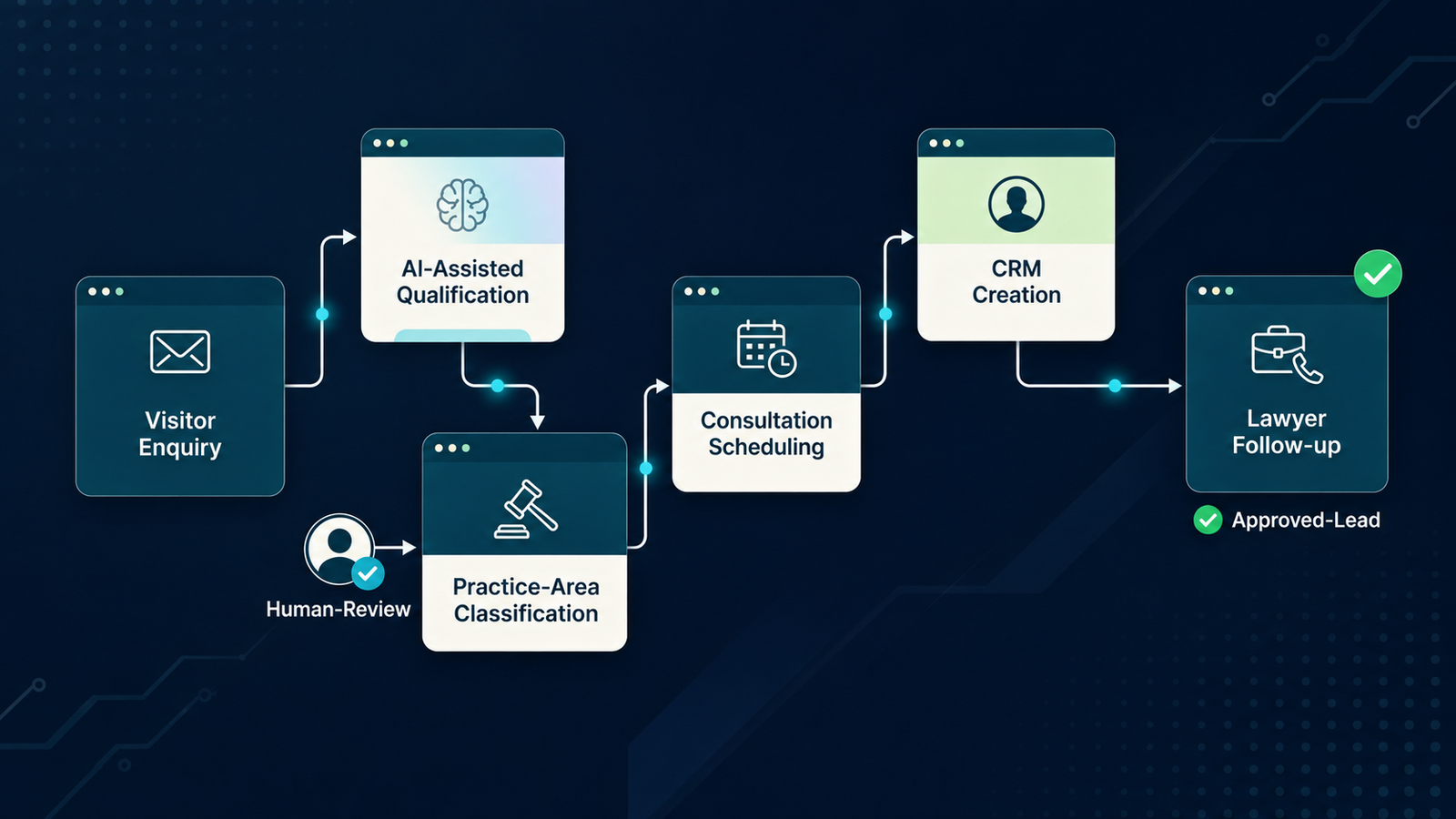
A common operational problem is that enquiries arrive through email, website forms and phone notes without a clear owner. Gemini may assist with drafting an internal classification suggestion from approved, appropriately cleared sample information, but the actual allocation of sensitive matters needs firm rules and review. Define conflict-check triggers, urgency categories, human escalation and explicit limits on what can be automatically sent. An assistant should not accept a legal engagement or disclose confidential facts by itself. Compare its suggested categories with a staff-reviewed reference set. Record misclassifications and how they were resolved. Firms seeking end-to-end routing may also need a separate automation platform, so the AI portion should not be confused with the systems that move tasks between users. Relevant source: American Bar Association, Formal Opinion 512 (29 July 2024).
Test output quality and information gain
Evaluate one process using ordinary examples, difficult examples and at least one refusal case. Define an approved answer using the source records before testing Gemini. Score completeness, factual accuracy, unsupported assumptions, practical usefulness and review effort. Record the product configuration and date. Do not invent time savings or treat a pleasant writing style as evidence of business benefit. If the tool repeatedly omits key qualifiers, keep the task under human control or narrow its scope. Check whether the output gives staff a better understanding of the task compared with a standard template. This is an operational decision framework, not an endorsement or claim that the publisher has completed a particular client implementation.
Train distinct roles and define escalation routes
Administrators need to know which controls are available and who can change them. Lawyers need to know when legal judgement and source checking are required. Business development staff need to distinguish factual firm information from generated marketing claims. Reception and intake staff must protect confidential enquiries and recognize requests that require immediate human attention. Use examples tailored to these responsibilities, including a misleading summary, an omitted deadline and a draft that reaches the wrong audience. Teach the staff member to stop, correct or escalate rather than hide the AI tool's mistake. A training record should describe demonstrated review ability, not merely show that someone attended a workshop.
Plan for international and changing legal requirements
A global firm may serve clients in different jurisdictions while using common technical services. Local duties about confidentiality, data protection, professional advertising and records management can differ. The ABA's Formal Opinion 512 and the SRA's 2026 notice offer relevant examples of professional oversight, but neither applies as universal law. Have regional counsel review data and public communication workflows where necessary. Official product capabilities may also change or become available in new editions, so assign a periodic verification owner. When updating a workflow, distinguish what changed in the product from what changed in professional obligations. Preserve a clear date and source citation beside material claims, particularly for regulated use cases. Relevant source: Solicitors Regulation Authority, Misuse of AI warning (17 August 2026).
Decide when to use other tools
A source-grounded notebook is suitable for a bounded set of approved reference documents, whereas enterprise legal agents may target contract reviews and regulatory tasks through specialist connectors. A rule-based automation platform may be better for predictable task routing. For legal research that affects advice or filings, official case law and legal databases remain necessary. The decision should describe the work, evidence required, authorized source and reviewer. Do not add another site page merely because a brand keyword has a slight variation. This page addresses operational management, while the Gemini for Lawyers guide addresses individual lawyer use and the Enterprise for Legal page addresses a different product with specialized capabilities and governance. Relevant cross-links should lead readers to those distinct decisions.
Illustrative Review Scenarios
These are hypothetical exercises, not verified vendor outcomes or client case studies.
Weekly internal reporting
A manager uses an approved example report to create a draft meeting summary and checks every key action against the original record.
Incorrect client statement
A draft email implies a guaranteed outcome. A responsible lawyer removes the unsupported claim and confirms the correct information.
Mixed-source confusion
A staff member attempts to combine confidential matter files with public training content. The process pauses for permissions review.
Choose the Guide That Matches Your Decision
| Decision | Related page | Why it differs |
|---|---|---|
| Individual lawyer use | /insights/gemini-for-lawyers/ | Personal task and document verification |
| Related work | /insights/gemini-enterprise-for-legal/ | Adjacent decision with different product or operating requirements |
| Tool discovery | /insights/legal-ai-tools-for-law-firms/ | Broader comparison and adoption questions |
These distinctions explain page purpose rather than implying performance superiority or vendor endorsement.
Frequently Asked Practical Questions
Is general Gemini the same as Gemini Enterprise for Legal?
No. They are distinct product experiences with different purposes and access conditions.
Can Gemini approve legal decisions or client engagements?
No. Those decisions require a responsible professional and relevant firm procedures.
Are Workspace integrations automatically authorized?
No. Actual product access, permissions, data terms and professional duties must be checked.
Sources, Scope and Limitations
The links below substantiate the provider's published feature descriptions and relevant professional duties. They do not establish availability in every account, compliance in a specific firm or the accuracy of model output. No rankings, search volumes, client results or affiliations are claimed.
- Google Cloud, Introducing Gemini Enterprise for Legal (25 August 2026) — Gemini Enterprise for Legal is not the same as general Gemini assistant; preview/access limitations apply.
- Google Cloud, Gemini Enterprise for Legal — Legal offering described as plugin to Gemini Enterprise; confirm product access and actual integrations.
- Google Workspace, Gemini Notebook (formerly NotebookLM) — Current product naming and features vary with account and edition; provider-stated privacy claims require contract review.
- Microsoft Learn, Power Platform data policies — Power Platform data policies provide connector governance; do not imply zero risk.
- American Bar Association, Formal Opinion 512 (29 July 2024) — US professional guidance; obligations depend on relevant rules, facts and jurisdiction.
- Solicitors Regulation Authority, Misuse of AI warning (17 August 2026) — Applies to SRA-regulated firms and practitioners in England and Wales; distinguish from global law.
- NIST, AI RMF Generative AI Profile — Voluntary risk-management reference, not a mandatory global legal code.
Related Research and Next Steps
Follow the links that match your specific professional task, platform or governance decision.
Discuss Your Next Practical Step
Explain your team, jurisdiction, existing software and the relevant decision so that any assessment stays appropriately scoped.
Review Gemini Workflows for My FirmAbout Dr. Rahul Dev
Dr. Rahul Dev is a PhD Data Scientist, Technology Law and Patent Attorney, AI Educator, and international business advisor with more than 20 years of professional experience. His work spans artificial intelligence, emerging technology, intellectual property, digital growth, technical research, and business strategy. Read the author profile.