
AI-Native Legal Revenue Platform for Law Firm Growth and Client Acquisition
Connect website, search, AI discovery, content, CRM, intake, analytics and automation into one measurable commercial system instead of managing each layer as a separate project.
Save or follow this source
Add AdvocateRahulDev.com to Google Preferred Sources or open this page in your preferred AI tool.
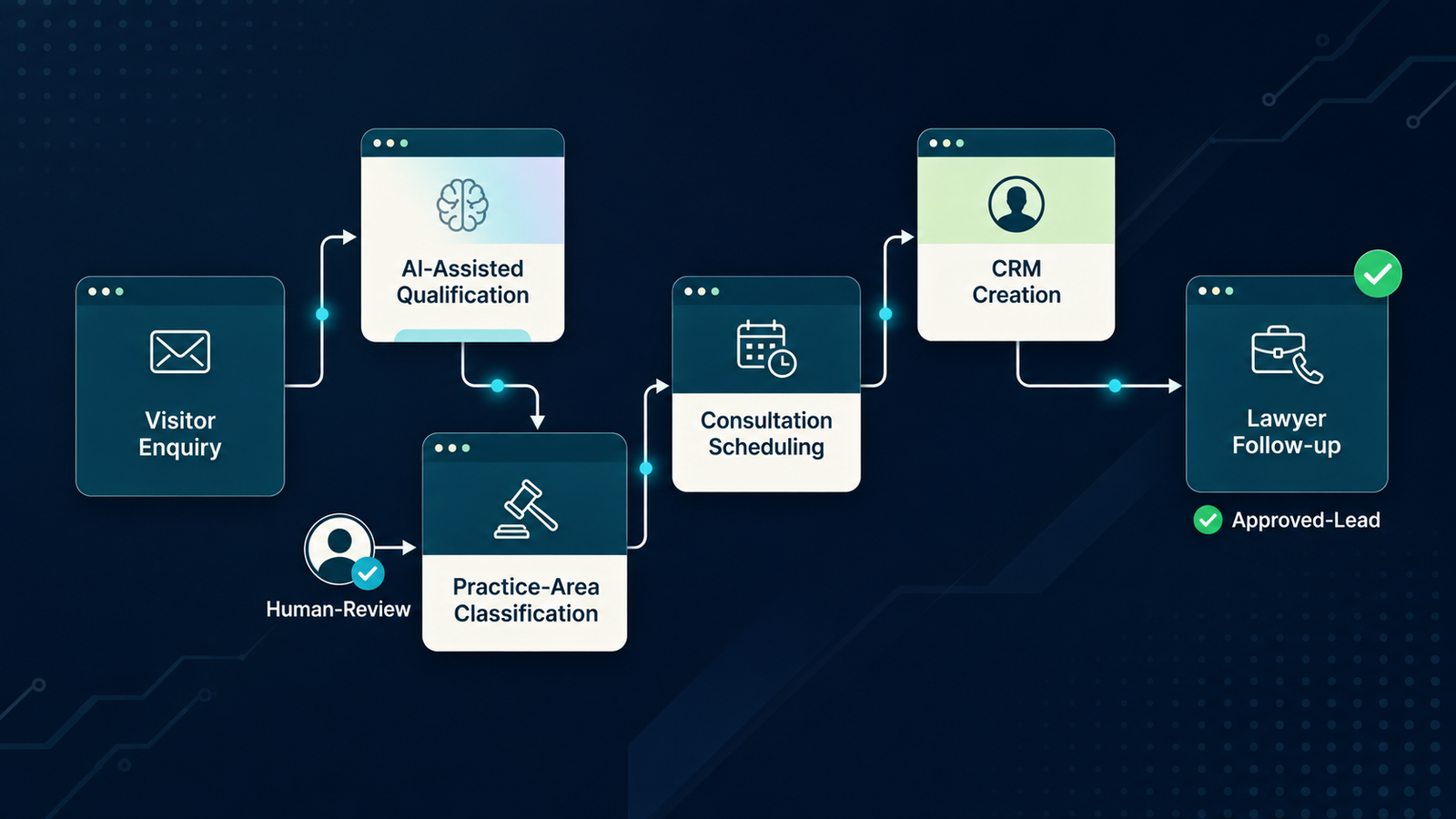
Connect the Revenue Journey, Not Just the Tools
Map how discovery, website experience, intake, CRM, follow-up and measurement currently connect—and where qualified opportunities are being lost.
Discuss Your Legal Revenue ArchitectureStop treating growth as a collection of disconnected tools
A law firm may have a modern website, SEO, paid campaigns, CRM, intake software, marketing automation, AI tools and analytics. A legal-tech company may have a product site, outbound sales, account-based marketing, CRM, demos, pilots and customer-success systems.
Each component can work independently while the commercial journey between them remains fragmented. The result can be weak visibility into where qualified demand originates, which opportunities deserve attention, where prospects are lost, how adoption progresses and what commercial activity is contributing to growth.
The objective of an AI-native legal revenue platform is not simply to add more software. It is to design the relationships between the layers.
AI-Native Legal Revenue Stack
Market → Discovery → Platform → Demand → Sales / Intake → Delivery / Adoption → Expansion → Revenue Intelligence
AI and data operate across the stack where they improve a defined workflow, while human judgment remains explicit where decisions are consequential.
Build around the buyer journey, not the technology stack
Market & Discovery
Define the ideal buyer, priority practice or product, sector, geography and differentiation. Build discoverability across search, AI systems, directories, paid channels, professional profiles and industry ecosystems.
Platform & Demand
Use the website and knowledge architecture to help qualified buyers understand relevance, evidence and next steps. Connect that platform to campaigns, research, outbound, partnerships, events and account-based activity.
Sales, Intake & Expansion
Move qualified demand through consultation or enterprise sales, then connect onboarding, adoption, client experience, renewals, additional matters, users, workflows and markets to measurable commercial intelligence.
One framework, two different revenue journeys
For Law Firms
Search / referral / AI discovery → service page → inquiry → intake → qualification → consultation → engagement → client experience → repeat, referral or cross-practice opportunity.
The consulting focus can include visibility, trust, website architecture, practice positioning, intake, CRM, business development, client experience and relationship growth.
For Legal-Tech Companies
Category awareness / outbound / event / search → product research → discovery → demo → pilot → security / procurement → contract → implementation → adoption → enterprise expansion.
The consulting focus can include go-to-market strategy, enterprise sales, legal engineering, demos, pilots, customer adoption, partnerships, revenue operations and market expansion.
Where AI can add commercial value
AI is most useful when it supports a defined commercial process rather than becoming the process itself. Depending on the organization, it may assist market and account research, buyer segmentation, content research, intake support, meeting preparation, proposal and RFP preparation, relationship intelligence, workflow recommendations and pipeline analysis.
The role of AI should be selected according to the business problem, data quality, risk profile and human-review requirements. The operating principle is simple: AI-native where useful, human-led where judgment matters, measurable throughout.
What the consulting scope can include
Strategy & Positioning
ICP, segment priorities, practice or product selection, market positioning, category definition and geographic expansion priorities.
Platform & Discovery
Website architecture, solution and practice pages, content systems, SEO, AI visibility, local search, entity presence, reputation and paid acquisition.
Demand & Sales
Account-based marketing, outbound, newsletters, events, CRM architecture, qualification, intake, enterprise discovery, demos, pilots, proposals and RFP workflows.
AI & Legal Engineering
Legal workflow mapping, AI-use-case design, agent workflows, knowledge architecture, implementation planning and human-review controls.
Client & Customer Growth
Onboarding, client experience, customer success, adoption, expansion, cross-sell and relationship intelligence.
Revenue Operations
Funnel definitions, attribution, dashboards, pipeline measurement, conversion analysis and commercial reporting.
Turn Disconnected Growth Systems Into One Operating Model
Identify the interfaces between search, AI discovery, content, intake, sales workflows and analytics that need to work as one commercial system.
Map Your Growth InfrastructureBuild, integrate or redesign?
Integrate
Connect systems that are already fit for purpose, such as website-to-CRM, intake routing, marketing attribution, relationship intelligence or AI-assisted workflow handoffs.
Replace Selectively
Replace a weak component where it creates disproportionate friction, such as an outdated website, poor intake, unusable CRM, fragmented knowledge or weak reporting.
Redesign the System
Consider a broader redesign when entering new markets, scaling after funding, building enterprise sales, consolidating offices or moving toward an AI-native operating model.
Measure more than traffic
Traffic, rankings and impressions can be useful indicators, but they do not describe the complete commercial system. Depending on the business, useful measures may include qualified traffic, inquiry rate, qualification rate, consultation or demo conversion, pipeline creation, sales-cycle duration, onboarding completion, product adoption, client or customer expansion and reliable source contribution.
The objective is not to force every relationship into a simplistic attribution model. It is to create enough trustworthy commercial visibility for better decisions.
Who this model is for
An AI-native legal revenue platform may be particularly relevant for law firms with fragmented growth systems, firms investing in AI without a connected commercial strategy, multi-office or international firms, legal-tech companies scaling enterprise sales, funded legal-AI companies entering new markets, companies building legal-engineering functions, and businesses with traffic but weak conversion or adoption.
It is less appropriate when the underlying market positioning remains unclear or when the organization only needs a narrow tactical repair.
The research behind the model
AI-native legal revenue platform is an AdvocateRahulDev.com analytical framework, not a standardized industry category. It combines developments already visible across legal marketing, CRM, business-development intelligence, client intake, AI-native legal-service models, legal engineering and revenue operations.
The research below examines those components, where they overlap, and the practical limitations of designing a connected commercial architecture.
What is an AI-native legal revenue platform?
An AI-native legal revenue platform is a connected commercial architecture for a law firm or legal-tech company that links market positioning, digital discovery, buyer education, intake or enterprise sales, client or customer growth, and revenue intelligence.
Its purpose is to solve a structural problem: organizations often acquire websites, CRM systems, intake tools, AI products, analytics platforms and business-development technologies independently. Each system may solve a narrow problem, but commercial performance depends on how well those systems connect across the buyer journey.
Current legal technology is already moving toward connected business and practice data. Litera, for example, has described products that combine firm intelligence, Microsoft 365, AI search and business-development workflows. These examples support the broader observation that legal growth technology is increasingly connecting relationship data, knowledge and commercial workflows rather than treating them as isolated systems.
A revenue platform therefore differs from a software bundle. Software is only one part of the architecture. The larger design problem is how information, workflows, people and commercial decisions connect.
Why websites and marketing systems alone do not define the revenue system
A law firm can have strong visibility and a modern website without having a strong revenue architecture. A legal-tech company can have product awareness without having a reliable enterprise-sales or adoption system. Traffic is only the beginning of the commercial journey.
Commercial friction can appear at any handoff: a visitor cannot identify the relevant service, an inquiry is not followed up, a legal-tech demo focuses on features instead of workflows, an enterprise pilot does not convert into adoption, or relationship data sits in a CRM without producing actionable business-development intelligence.
The strategic question is therefore not simply which marketing tools to buy. It is how the organization should connect demand, relationships, sales or intake, delivery and commercial intelligence.
The eight layers of the AI-Native Legal Revenue Stack
- Market: define the ideal client or customer, practices or products, sectors, geographies and differentiation.
- Discovery: establish visibility across search, AI systems, directories, paid channels, referrals and industry ecosystems.
- Platform: help buyers understand relevance, evidence and next steps through a coherent digital experience.
- Demand: create identifiable opportunities through research, content, campaigns, outbound, events and partnerships.
- Sales or Intake: convert qualified interest into consultation or an enterprise buying process.
- Delivery or Adoption: connect onboarding, implementation, training and service experience to the commercial relationship.
- Expansion: identify relevant additional matters, products, users, workflows, offices or markets.
- Revenue Intelligence: use dependable data to understand source contribution, pipeline, conversion, adoption and relationship growth.
AI may assist several layers, but it should support a defined workflow rather than substitute for commercial design.
Law-firm and legal-tech revenue architecture are not interchangeable
Law firms primarily sell professional services. Buyers may evaluate expertise, trust, jurisdiction, responsiveness, experience, reputation, commercial understanding and relationship quality. Legal-tech companies sell products or technology-enabled services and may face buyer education, workflow diagnosis, demos, pilots, security review, procurement, implementation, usage, renewal and expansion.
This difference matters because the same high-level framework can apply while the operational implementation remains materially different. A law-firm intake system should not be copied into an enterprise SaaS sales organization, and an enterprise demo/pilot motion should not be imposed on a consumer legal practice.
Where AI belongs in the revenue system
AI can assist market intelligence, segmentation, research, meeting preparation, content support, intake summaries, relationship intelligence and pipeline analysis. The relevant question is whether AI improves a specific task without creating disproportionate risk or ambiguity.
As agentic systems become more capable of executing multi-step actions, governance becomes more important. Human judgment remains particularly important for legal advice, sensitive communications, conflicts, pricing, account strategy, negotiation, regulated marketing and consequential automated actions.
Revenue Platform Maturity Model
1. Fragmented
Tools exist independently and commercial handoffs are difficult to observe.
2. Connected
Core systems exchange useful information and basic routing or attribution works.
3. Measured
Leadership can observe important stages of the commercial journey and identify friction.
4. AI-Enabled
AI assists defined tasks such as account research, intake summaries, content support or relationship intelligence.
5. AI-Native
Commercial architecture is designed around connected data, AI-assisted workflows and explicit human review from the outset.
This maturity model is an AdvocateRahulDev.com analytical framework, not an external industry standard.
Why AI efficiency creates a revenue-model question
AI can reduce the time required for some legal or commercial tasks, but efficiency does not automatically produce stronger commercial performance. Firms still need to decide how saved time affects pricing, client value, business development, service design and relationship growth.
This creates an important planning principle: AI transformation and revenue strategy should not be designed independently. An organization can become more efficient without improving market positioning, intake, adoption or expansion.
Client intelligence is becoming part of growth infrastructure
Recent legal-technology development increasingly connects relationship data, business development, knowledge, intake and AI-assisted analysis. That does not mean one vendor should perform every function. It means organizations need to understand the architecture between those functions.
A useful revenue architecture therefore asks not only where client or customer data is stored, but how it moves between marketing, sales or intake, service delivery, relationship management and leadership decisions.
When this model is most useful
The framework is most relevant when the problem is systemic rather than tactical: a law firm has good traffic but poor conversion; AI investment is disconnected from commercial strategy; a legal-tech startup has raised funding and needs GTM infrastructure; a company is entering a new country; or a multi-office firm needs stronger relationship and cross-office intelligence.
In each case, the useful first step is to diagnose the entire journey before selecting a technology or vendor.
Limitations of the model
The framework does not guarantee revenue growth. Technology cannot repair weak market positioning, and poor data can limit AI usefulness. Integrations create security, maintenance and governance requirements. Attribution remains imperfect in legal markets where referrals, offline relationships and long sales cycles may matter. Professional obligations around confidentiality, advertising, supervision and client communication remain jurisdiction-specific.
For many legal businesses, commercial strength will depend on combining technology with human judgment and relationships rather than choosing one over the other.
Frequently Asked Questions
What is the difference between a law-firm website and a legal revenue platform?
A website is one component. A revenue platform additionally considers discovery, demand generation, sales or intake, CRM, relationships, adoption, expansion and measurement.
Does an AI-native revenue platform require replacing existing technology?
No. Integration may be more appropriate where existing systems are fit for purpose. Replacement should follow a demonstrated workflow, data or user-experience problem.
Is this only for large law firms?
No. The architecture can be simplified for smaller organizations. Appropriate scope depends on business complexity, buyer journey and available systems.
How is this different for legal-tech companies?
Legal-tech companies typically require enterprise sales, demos, pilots, procurement, implementation and customer adoption. Law firms usually require client discovery, intake, engagement and relationship development.
Does AI automatically improve law-firm revenue?
No. AI may improve defined workflows or commercial intelligence, but outcomes depend on positioning, implementation, adoption, data quality, client needs and other factors.
Where should an organization start?
Start by mapping the commercial journey and identifying the highest-friction handoffs before deciding which technology, workflow or service should change.
Sources and Further Reading
- FindLaw Lawyer Marketing services — current integrated legal-marketing service categories.
- Litera Foundation 365 — relationship intelligence and Microsoft 365 integration.
- Litera AI Search and Business Development — current AI and business-development intelligence positioning.
- Nexl resources — law-firm relationship and growth platform context.
- The AI-Native Law Firm, Executive Summary — current operating-model discussion.
- International Bar Association — professional analysis of AI-native legal-service delivery.
- Thomson Reuters Future of Professionals 2026: Legal — client expectations, AI and commercial-model context.
Research note: Vendor examples illustrate current market directions and do not imply endorsement of this AdvocateRahulDev.com framework.
Related Research and Services
- AI-Native Law Firm
- Legal-Tech Go-to-Market Consulting
- Legal-Tech Growth Consulting
- Law Firm Website Design
- Law Firm SEO
- Law Firm AI Search Visibility
- Law Firm Lead Generation
- Law Firm Website Conversion
- Digital Growth Advisory
- AI Visibility for Law Firms
- Legal Technology
- Client Intake for Law Firms
- Legal Engineering Consulting
Build the Commercial System Around the Firm You Want to Become
Prioritize the data, workflow, technology and client-acquisition layers required to support scalable legal business growth.
Discuss an AI-Native Growth Platform