
Legal Engineering Consulting for AI, Legal-Tech and Law-Firm Workflows
AI can perform impressive legal tasks in a demonstration and still fail when introduced into the way lawyers actually work. Legal Engineering connects legal expertise, process design and technology to build workflows that legal professionals can understand, test, use and improve.
Save or follow this source
Add AdvocateRahulDev.com to Google Preferred Sources or open this page in your preferred AI tool.
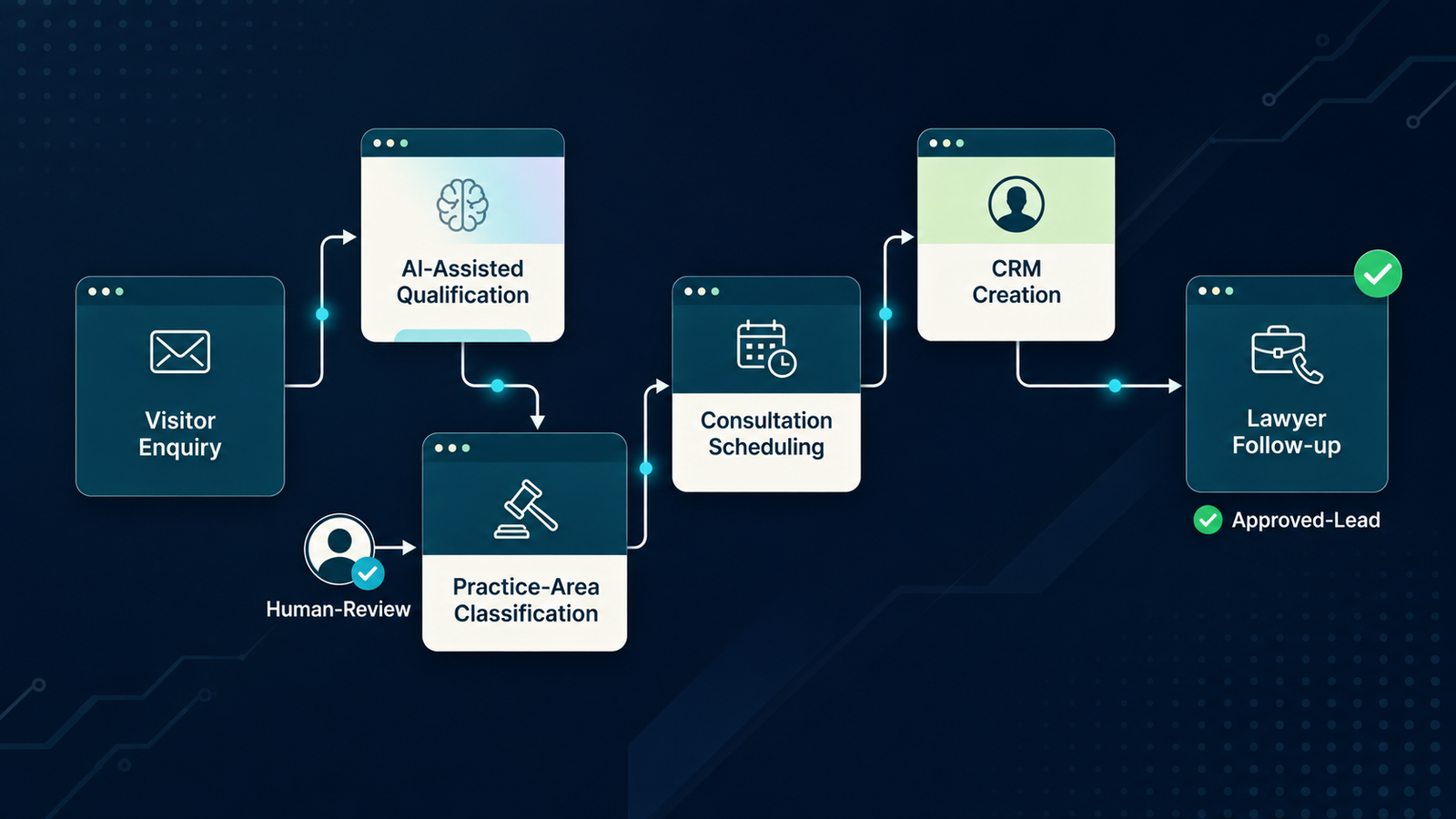
Turn Legal AI Capability into Legal Workflow
Map the legal process, technology role, review points and adoption requirements before scaling AI or software across the organization.
Map a Legal WorkflowTechnology capability is not the same as legal-workflow fit
A product may be technically capable of drafting, research, review, extraction, summarization, analysis or automation. A legal organization still needs to determine which task should change, what information enters the workflow, what AI should do, what a lawyer should review, where errors matter and how quality should be evaluated.
Those questions sit at the heart of Legal Engineering. The goal is not maximum automation. It is to design technology-enabled legal workflows that are understandable, testable and usable in practice.
The Legal Engineering Bridge
Legal Workflow ↔ Product ↔ Sales ↔ Implementation ↔ Adoption
Each connection creates a potential failure point. Legal Engineering makes those interfaces explicit.
For legal-tech and legal-AI companies
Commercial translation
Turn product capability into legal use cases, practice-specific demonstrations, pilots and proof-of-value that legal buyers can evaluate.
Adoption and feedback
Connect implementation and customer usage back into product development, training, workflow refinement and expansion.
Legal Engineering can support workflow discovery, use-case design, demos, pilot design, implementation planning, use-case libraries, sales enablement, customer education, adoption and product feedback.
For law firms and legal departments
The same discipline can be applied from the buyer side. A law firm or legal department may need process mapping, AI opportunity identification, workflow redesign, build/buy/integrate decisions, pilot design, testing, human-review controls, implementation, training and adoption.
The objective is to identify where technology can participate usefully while keeping legal judgment, supervision and accountability explicit.
Five tests of an AI-enabled legal workflow
1. Legal-value test
Does the workflow solve a meaningful legal or business problem?
2. Workflow-fit test
Does it match how the legal team actually performs the work?
3. Reliability test
Can outputs be evaluated adequately for the intended use?
4. Human-review test
Are judgment, approval and escalation points explicit?
5. Adoption test
Can intended users realistically incorporate the workflow into daily practice?
These tests are an AdvocateRahulDev.com analytical framework rather than an external industry standard.
The Legal Engineering Lifecycle
Discover → Map → Design → Build → Test → Deploy → Enable → Measure → Improve
Discover and Map
Understand the legal need, users and intended outcome, then document the current process and decision points.
Design and Build
Define the target workflow, AI role and human checkpoints, then configure the relevant tools, instructions, integrations and process components.
Test and Deploy
Evaluate quality, usability and failure modes before introducing the workflow into real work under appropriate controls.
Enable, Measure and Improve
Train users, assess usage and quality, and use observed problems and feedback to refine the workflow or product.
Map the Workflow Before Automating It
Identify the current process, technology opportunity, review requirements and adoption barriers before scaling the solution.
Map a Legal WorkflowBuild a Legal Engineering function
For growing legal-AI companies or larger legal organizations, the need may go beyond one workflow. A Legal Engineering operating model can define role responsibilities, interaction with Sales, Product and Customer Success, workflow-discovery methods, demo and pilot standards, evaluation methods, implementation handoffs, adoption responsibilities and feedback loops.
Different organizations use different titles. The important capability is the ability to translate legal work into systems and systems back into workable legal practice.
Legal Engineering is not prompt engineering
Prompt design can be useful, but Legal Engineering is broader. It can involve process analysis, workflow redesign, technology selection, integrations, knowledge inputs, evaluation, governance, implementation, training and change management.
A well-written prompt cannot compensate for a poorly designed legal process.
Legal Engineering is not simply software implementation
Software implementation usually begins with a selected product. Legal Engineering may start earlier by asking what the legal workflow should become, which technology belongs inside it, what integrations are required, where people remain responsible and how success should be evaluated.
Implementation can therefore sit inside Legal Engineering rather than define the discipline entirely.
The research behind Legal Engineering
Legal Engineering is still developing as a discipline, but the underlying need is increasingly visible across legal-AI and legal-tech organizations. Current role structures show legal-domain experts working across discovery, demonstrations, pilots, implementation, training, adoption and product feedback.
What is Legal Engineering?
Legal Engineering is the discipline of combining legal expertise, technology fluency and process design to improve how legal work is performed. In current AI-oriented practice, it frequently involves understanding legal tasks, mapping workflows, identifying appropriate AI or automation opportunities, designing improved processes, evaluating technology, implementing solutions, training users and monitoring adoption.
Harvey currently describes the function as combining legal expertise, AI and technology fluency, process design and improvement, and influence and user enablement. It states that Legal Engineers work across law firms, corporate legal departments and legal-technology companies.
The term is not fully standardized across the industry. Organizations may use related titles such as Legal Architect, legal technologist, solutions specialist or innovation professional.
Why Legal Engineering is becoming more important
Generative AI has made it easier to demonstrate individual legal tasks. The harder problem is operational. The organization still needs to decide when the tool should be used, what information it should receive, how outputs should be checked, what happens when confidence is low, which users should participate, how the workflow interacts with existing systems and how quality should be measured.
That difference creates the need for a function that understands both the legal process and the technology.
Legal Engineering in enterprise sales
A technically successful product demonstration may still fail to establish workflow relevance. The buyer may understand what the system does but remain uncertain about where it fits, who uses it, what changes, how outputs are reviewed and what implementation requires.
Current company structures reflect this challenge. Clio's sales organization currently includes multiple Legal Architect roles alongside Enterprise Sales positions and Solutions Engineers. Harvey similarly places Legal Engineering close to the customer and commercial lifecycle.
The practical implication is that enterprise legal-tech selling can require two separate validations: technical fit, meaning whether the technology can operate, and legal-workflow fit, meaning whether it can operate meaningfully inside the user's actual legal process.
Legal Engineering in demos and pilots
A conventional feature demo asks what the software can do. A Legal Engineering-led demonstration asks how a specific legal team would perform a specific task differently.
A workflow-led demonstration can begin with the current process, current friction, technology intervention, human-review point, resulting workflow and testable outcome. A pilot can likewise define the target workflow, users, source material, evaluation criteria, review responsibility, time period and success or failure conditions.
Without those elements, a pilot can produce enthusiasm without producing a reliable deployment decision.
Legal Engineering for legal-tech companies
A vendor-side Legal Engineering function can support customer discovery, legal workflow analysis, use-case design, demonstrations, pilots, proof-of-concept work, implementation, adoption, training and product feedback.
The consulting opportunity is not necessarily to replace an internal Legal Engineering team. It can include helping a company establish role definitions, workflow-discovery templates, use-case libraries, demo standards, pilot methodology, handoffs between Sales, Product and Customer Success, and adoption playbooks.
Legal Engineering for law firms and legal departments
On the buyer side, the function starts from the legal process rather than the product. A typical sequence may be: current process → pain point → AI opportunity → target workflow → human review → pilot → evaluation → adoption.
Examples can include research, contract review, document analysis, drafting, transaction workflows, litigation workflows, knowledge retrieval and internal legal operations.
A good Legal Engineering process may conclude that a workflow should remain largely human-led. The function exists to make that determination deliberately.
Legal Engineering and product feedback
Legal Engineering can produce valuable product intelligence. A Legal Engineer working with users can observe which workflows matter, where people hesitate, which steps are difficult, what users misunderstand, which features are missing and where quality problems appear.
That information can feed back into Product through a loop such as Legal User → Legal Engineer → Product → Improved Workflow → Legal User. For legal-tech companies, this connects commercial learning to product development.
Legal Engineering and adoption
Technical deployment does not necessarily produce behavioral adoption. Users may avoid the product, use only basic functions, distrust outputs, revert to old workflows or misunderstand where human review is required.
Training, enablement, internal champions, operating guidance and feedback loops therefore matter alongside implementation. Adoption should be evaluated as an operating question, not assumed from technical availability.
Vendor-side and buyer-side Legal Engineering
Vendor-side
Workflow discovery, use-case creation, demo architecture, pilot design, product feedback, implementation playbooks, adoption support and sales enablement.
Buyer-side
Current-process mapping, AI opportunity analysis, product/workflow evaluation, pilot governance, workflow redesign, implementation planning, user enablement and change management.
The underlying capability is the same: translate legal work into systems, and systems back into workable legal practice.
When Legal Engineering consulting makes sense
Legal Engineering may be particularly relevant when a legal-AI product is technically strong but difficult to explain commercially, enterprise demos are too generic, pilots are not converting into rollout, lawyers are experimenting with AI without standardized workflows, a firm has multiple AI tools but limited adoption, a legal-tech company is establishing its first Legal Engineering team, or an existing team needs repeatable methods.
It may be less useful where the underlying technology cannot support the intended use case or where the legal process itself has not been defined sufficiently.
Limitations and risks
Legal Engineering does not eliminate the risks associated with legal AI. Important limitations include technology limitations, unreliable outputs, confidentiality considerations, data-quality problems, integration complexity, professional obligations, jurisdiction-specific requirements and resistance to workflow change.
Legal Engineering can create a more systematic way to identify and manage these issues. It cannot make them disappear.
Practical conclusion
Legal Engineering addresses the difference between technology that can perform a legal task and a legal organization that can reliably use the technology inside real work.
Current market structures provide strong evidence that this bridge is becoming organizationally important. Harvey explicitly defines and promotes Legal Engineering as a distinct discipline, Clio employs Legal Architects inside its sales organization, and Legora publicly identifies Legal Engineer as a role within its company.
For AdvocateRahulDev.com, the service proposition remains: Legal Engineering connects legal work, product capability, enterprise selling, implementation and sustained adoption.
Frequently Asked Questions
What does a Legal Engineer do?
A Legal Engineer combines legal understanding, technology knowledge and process design to create, evaluate and implement technology-enabled legal workflows.
Is Legal Engineering the same as prompt engineering?
No. Prompt design may be one technique, but Legal Engineering can also involve workflow analysis, process redesign, evaluation, integrations, implementation, governance and user adoption.
Can Legal Engineering help legal-tech companies sell software?
Yes. It can support workflow discovery, demonstrations, pilots, proof-of-value and sales enablement where legal-domain expertise materially affects the buying decision.
Can law firms use Legal Engineering internally?
Yes. Law firms and legal departments can use the discipline to map processes, identify AI opportunities, design pilots, establish review points and improve adoption.
Does every legal AI workflow require automation?
No. Legal Engineering may determine that some work should remain human-led or that AI should support only a limited part of the process.
How should a Legal Engineering project begin?
Begin with the legal process and intended outcome, then map the current workflow before selecting or configuring technology.
Sources and Further Reading
- Harvey — What Is a Legal Engineer? — current definition, competencies and legal-workflow framing.
- Harvey Legal Engineer — current responsibilities across discovery, demos, onboarding, workflow design and customer work.
- Harvey Legal Engineer role — workflow-specific enterprise sales and the company's use of the "legal win" concept.
- Harvey Legal Engineer Product Specialist — post-sale workflow integration, adoption and utilization responsibilities.
- Clio Sales Careers — current Legal Architect, enterprise sales and solutions-engineering roles.
- Clio New York Careers — enterprise Legal Architect and account-executive context.
- Legora Careers — current Legal Engineer role context.
Research note: External company examples illustrate current market structures and do not imply endorsement of AdvocateRahulDev.com or its consulting framework.
Design Legal AI Around Real Legal Work
Connect workflow discovery, technology, human review, implementation and adoption into one practical operating model.
Discuss Legal Engineering with Dr. Rahul Dev